8 nor did we eat anyone’s food without paying for it. On the contrary, we worked night and day, labouring and toiling so that we would not be a burden to any of you.
누구에게서든지 양식을 값없이 먹지 않고 오직 수고하고 애써 주야로 일함은 너희 아무에게도 누를 끼치지 아니하려 함이니
Paul’s way of life was a model for Christians to follow. He worked hard first to sustain himself and second to share with those in need (Eph 4:28; 1 Thes 4:11). Paul called this kind of organic relationship ‘loving each other’ (1 Thes 4:9), for through such financial support for oneself and for one another, believers were enabled to lead a ‘proper’ Christian life, not having to negotiate their identity in order to gain favour from any other social or business sources which were almost certainly pagan and involved extensive idol worshipping practices. So, more than we can imagine, it was essential that Christians were able to sustain oneself and to maximise the income while minimising the cost for oneself so that they could help other believers to keep their dignity and allegiance.
9 We did this, not because we do not have the right to such help, but in order to offer ourselves as a model for you to imitate.
우리에게 권리가 없는 것이 아니요 오직 스스로 너희에게 본을 주어 우리를 본받게 하려 함이니라
Paul and the companion too had every right to have access to such loving help between Christians. But for the sake of setting the example, Paul was at the giving end rather than at the other, receiving, end.
10 For even when we were with you, we gave you this rule: ‘The one who is unwilling to work shall not eat.’
우리가 너희와 함께 있을 때에도 너희에게 명하기를 누구든지 일하기 싫어하거든 먹지도 말게 하라 하였더니
So, this ‘rule’ of labour was put in place so that the practical love of sustaining each other’s Christian life would be possible. For ‘If the whole body were an eye, where would the sense of hearing be? If the whole body were an ear, where would the sense of smell be?’ (1 Cor 12:17). If everyone was to receive only there would be no one that could give. Therefore Paul would like to equip everyone as an able giver that there would no one ‘in any need’ (1 Thes 4:12, NASB; 아무 궁핍함이 없게).
Then what would be the equivalent thing in this modern world that would enable each other to sustain Christian life that they do not need to go out and having to negotiate their identity in order to survive?
Lord, thank you for your lesson today that is practical and exposing. We, with or without knowing, drive other Christians into places they would have to negotiate their identity. We make them fail by implicitly placing idols in front of their desperate hearts where you should stand. O Lord, this is the very act of making a weak brother stumble you have warned us about (Luke 17:2). The penalty would be as much as tying ourselves onto the millstone and falling into the sea, the same fate as that of Satan’s stronghold (Rev 18:21). Have mercy Father, that we do not let Satan dwell in us, when we say we are your children. Let us flee to you so that we will be shielded from the evil one’s scheme (Ps 2:12). Let us open our eyes to your true love, be sustained and sustain our brothers and sisters through our labour. Lord have mercy. Amen.
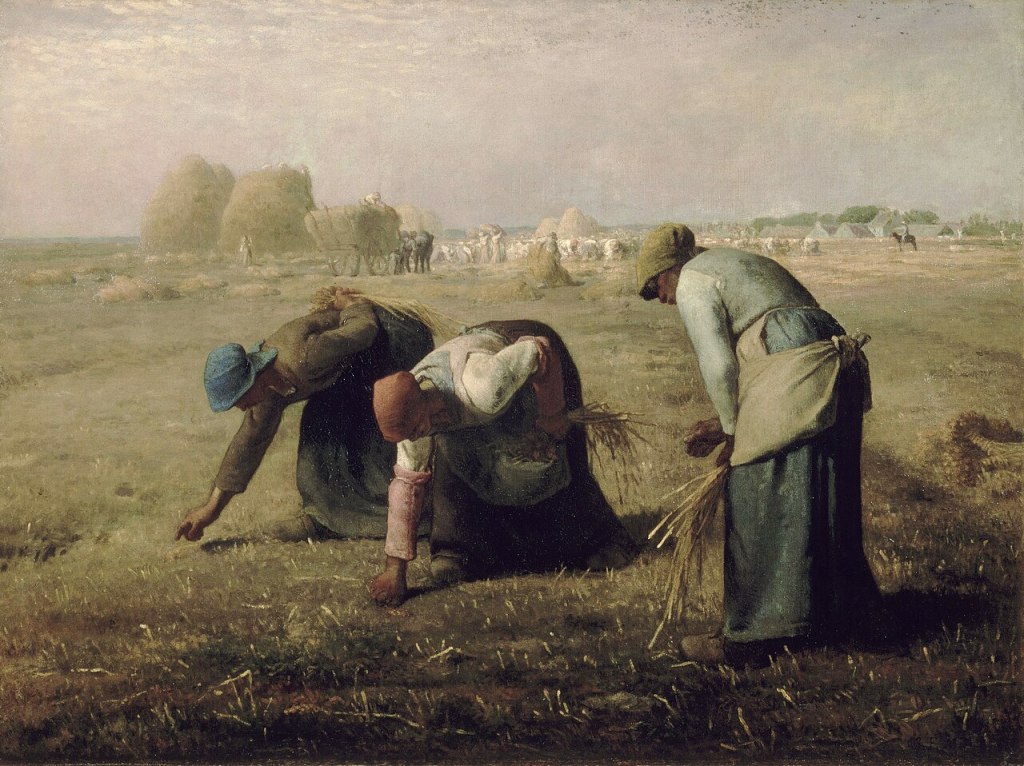
Image: Jean-François Millet, Gleaners. Public Domain.
 Read with Ssam