15 Here is a trustworthy saying that deserves full acceptance: Christ Jesus came into the world to save sinners – of whom I am the worst.
미쁘다 모든 사람이 받을 만한 이 말이여 그리스도 예수께서 죄인을 구원하시려고 세상에 임하셨다 하였도다 죄인 중에 내가 괴수니라
Christ who has considered, judged, governed, Paul to be faithful because of the strength he gives can be summarised again in this faithful saying: Jesus came to save sinners.[1] To save, to be saved, salvation… we have heard this word so many times, we almost grew numb to it. But it originally means to bring to safety, to restore health. In turn it implies we were endangered and fell ill.[2] Paul says he is the worst of them (or rather, us); ESV and NASB translate more fittingly as foremost. This is less in the sense that Paul’s degree of sinfulness is the most serious when weighed against others; but more in the sense that he is the example and the forerunner in showing how Christ’s faithfulness works in believers.[3] This idea is followed in the next verse.
16 But for that very reason I was shown mercy so that in me, the worst of sinners, Christ Jesus might display his immense patience as an example for those who would believe in him and receive eternal life.
그러나 내가 긍휼을 입은 까닭은 예수 그리스도께서 내게 먼저 일절 오래 참으심을 보이사 후에 주를 믿어 영생 얻는 자들에게 본이 되게 하려 하심이니라
‘The very reason’ indicates back to the faithful saying: Jesus came to save sinners. As the pattern and the example, Christ has exhibited what it takes to make an unbeliever into a believer: His immense patience and the full power of turning the dead to life (v.14). In light of this patience and faithfulness Paul called the believers ‘who would[4] believe (were to, ESV)’. But this is entirely to do with Christ showing his faithfulness first; and nothing to do with our potential to come to believe, as noted in v.13. Therefore, if there is any condition on our side to be saved, it is ‘being a sinner’, for that is whom Christ came to save.
17 Now to the King eternal, immortal, invisible, the only God, be honour and glory for ever and ever. Amen.
만세의 왕 곧 썩지 아니하고 보이지 아니하고 홀로 하나이신 하나님께 존귀와 영광이 세세토록 있어지이다 아멘
A short doxology before reaffirming his instruction to Timothy. Paul almost can never pass without praising God, when he talks about how God saved us. I talk and think much but hope to praise all the more.
Lord, Thank you for your purpose of coming to save me. I had fallen into a danger and fallen ill. You came in person to lift me up from that danger and illness. Lord let your work be displayed in me. Make me your example. Make me speak kind and patient words but mighty words of love, without nearly turning back into the monster you have already dealt with and tamed. Before we instruct or teach anyone, let us immerse into your love, your compassionate character that moves the whole universe to turn me to you. Thanks be to our God who is invisible but visible through me. Praise be to our Lord’s faithfulness and almightiness that he trusts me and enables me.
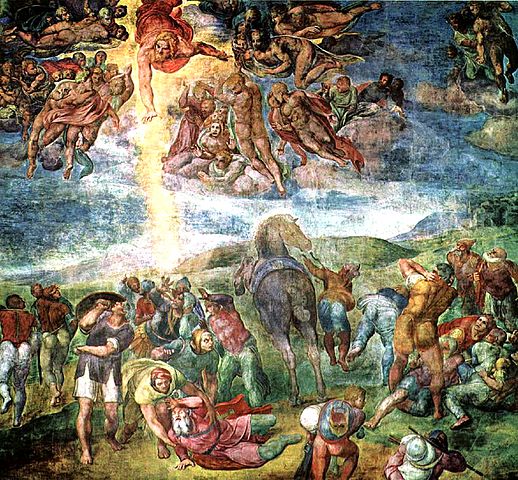
Image: The Conversion of Saul, a fresco by Michelangelo developed between 1542 and 1545 From Web Gallery of Art – http://www.wga.hu/index1.html. Public Domain
[1] ἁμαρτωλός (hamartōlos) ‘sinful’ (G0268)
(a.) sinful, as an absolute moral failure; (n.) sinner, one who violates God’s will or law; in some contexts, one who does not keep orthodox traditions and behaviors. one who deviates from the path of virtue, a sinner, Mk. 2:17; depraved, Mk. 8:38; sinful, detestable, Rom. 7:13
[2] σῴζω (sōzō) ‘to save’ (G4982) to bring safely, restore to health
[3] πρῶτος (prōtos) ‘first: best’ (G4413J): best/most_important, first (chronologically or in order of importance)
[4] μέλλω (mellō) ‘to ensue’ (G3195) (Verb Present Active Participle Genitive Plural Masculine ) to be about to, on the point of; to be destined, must; to intend to; (what is) to come, the future
to be about to, be on the point of, Mt. 2:13; Jn. 4:47; it serves to express in general a settled futurity, Mt. 11:14; Lk. 9:31; Jn. 11:51; to intend, Lk. 10:1; participle μέλλων, μέλλουσα, μέλλον, future as distinguished from past and present, Mt. 12:32; Lk. 13:9; to be always, as it were, about to do, to delay, linger, Acts 22:16
 Read with Ssam