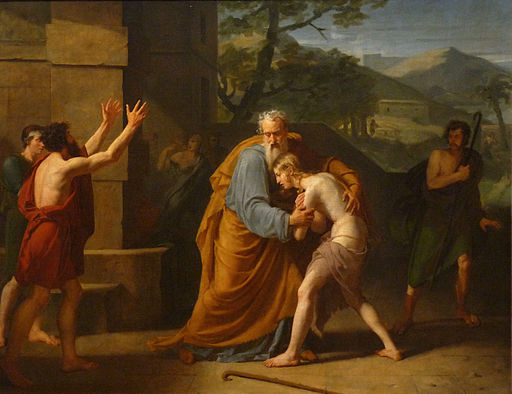
You might think this picture is irrelevant to today’s theme, but at the end of reflecting on this passage, I discover that man’s heart is like that of the brother of the prodigal son, who is always under stress, worrying what duty I am going to be placed with now, what sacrifice and disadvantage I have to put myself in for, etc. But no! We misunderstand God because we neither know His power nor His word! Read about the abundance of God that He desires to give to all through the believer’s life and that He first gave all to us.
8 Therefore I want the men everywhere to pray, lifting up holy hands without anger or disputing.
Bible passages often begin with ‘therefore’, ‘for’ or ‘then’. It is important to trace what previous statement or argument that conjunction refers to. Here the conjunction οὖν (oun) is used, meaning ‘so then’, which marks coming back to the subject.[1] So it is all the more worthwhile to note the main theme Paul has been dealing with. As concluded yesterday, we should pray for all people (v. 1) because God the Mediator gave himself for all people (v. 6); prayerfulness should also be reflected in a modest lifestyle, displaying God’s love for the world (v. 2).
So then, if this is so, what should men do? They should use their hands to pray, not to express their anger or dispute. ‘Strengthen the feeble hands, steady the knees that give way’, Isaiah said (Isa 35:3). What for? To tell people, ‘He will come to save you’ (Isa 35:4)!
So men are not to give their hands in to their weaknesses but to commit them to a prayerful life so as to declare God’s saving plan for people (v. 4).
9 I also want the women to dress modestly, with decency and propriety, adorning themselves, not with elaborate hairstyles or gold or pearls or expensive clothes,
‘Similarly’, ‘likewise’, ‘in the same way’ as men,[2] Paul gives this instruction to women, which is in essence to lead a modest lifestyle for the sake of God as his image-bearing creature, just like men. This is an important concept to grasp at this point in preparation for the following passage. In New Testament times, in Ephesus, the goddess Artemis was worshipped. Women priests in particular were deified; they were even free to seduce men as part of their worship. Their dress was quite extravagant. They were the models to follow for women in Ephesus, exhibiting the powerful fertility of the goddess Artemis.
10 but with good deeds, appropriate for women who profess to worship God.
But who are women in the eyes of the God who made them? They are the image bearers of Him as much as the men are, and they are His creatures as much as the men are. In place of extravagance, therefore, women are to dress with humility, modesty, and prayerfulness to exhibit God’s desire that all people should come to know him and be saved.
Dear Lord, We misunderstand you so much because we neither know your power nor your word. You are not a God who constrains or deprives us. Rather, you are a God who fills us abundantly, first with your grace so that we may come to know you and, second, with all your godly qualities to be exhibited in our lives. What you have is ours! Let us not resentfully grumble against you, saying that you are mean to us, prohibiting men from this and women from that. Because you are not! All the time we have been with you, you’ve seen us as the same and equal image bearers, men and women. You have been truly gracious to us, giving and sharing everything that is yours with us. You consider us legitimate children of yours who deserve such treatment, all because of Christ. Let us profess that. Let us, men and women, pray with our lives. Let us be proud of who we are—the beloved children who belong completely to you. Praise be to your name. Amen.
Image: Michel Martin Drolling (1786–1851), Le retour de l’enfant prodigue (Return of the Prodigal Son), 1806. Musée des Beaux-Arts de Strasbourg, via Wikimedia Commons
[1] οὖν (oun) ‘therefore/then’ (G3767) therefore, then, so then
then, now then, so then Mt. 13:18; Jn. 19:29; then, thereupon, Lk. 15:28; Jn. 6:14; therefore, consequently, Mt. 5:48: Mk. 10:9; it also serves to mark the resumption of discourse after an interruption by a parenthesis, 1Cor. 8:4. Sometimes it is not translated. HELPS Word-Studies
[2] ὡσαύτως (hōsautōs) ‘likewise’ (G5615). in the same way, so also, likewise, similarly
just so, in just the same way, so also, or manner, likewise, similarly Mt. 20:5; 21:30, HELPS Word-studies
Bibliography
Ray Vander Laan, Artemis of the Ephesians, That The World May Know.https://www.thattheworldmayknow.com/artemis-of-the-ephesians#:~:text=What%20role%20did%20Ephesus%20have,the%20cult’s%20purity%20of%20worship.
‘The Temple of Artemis at Ephesus’, University of Warwick. https://warwick.ac.uk/fac/arts/classics/intranets/students/modules/greekreligion/database/clumak/
‘Great Was Artemis of the Ephesians’, NT Wright Online. https://www.ntwrightonline.org/great-was-artemis-of-the-ephesians/
 Read with Ssam