The debate is hot but almost always loses to the complementarian view that constrains women believers. Yes. The grounds are on Creation. But today I would like to review why the Creation was taken as the basis of Paul’s argument on this occasion.
11 A woman should learn in quietness and full submission.
This is the main command Paul gives to women. Women, as they have been created as helpers (Gen 2:18, 20), what would be their due quietness and full submission? Surely it is not what the Artemis prophetesses or their followers display. Nevertheless, the helper’s job is not just a hand on the side either. Rather, it is about being of one mind and completely in agreement with the other. When we consider that Jesus called the Holy Spirit ‘another Helper’ (John 14:16, ESV), we can more easily understand this concept of a helper. More over, if the Holy Spirit is another Helper, it also implies Jesus is a helper himself. They both, as helpers, understood the Father perfectly and had His mind. Not only that, they actively performed and fulfilled the Father’s plan. Therefore, ‘quietness and full submission’ are far from being passive and reserved. It is active and positive, but not like the Artemis prophetesses, who deify themselves. It is the attitude of understating and fulfilling the purpose of the One who made her, together with the other half.
12 I do not permit a woman to teach or to assume authority over a man; she must be quiet.
Again, a woman is not a goddess, as obvious as it might be to us. She is God’s creation and should be humble before God’s intention for her, just as a man should be.
13 For Adam was formed first, then Eve.
So by now we should understand that Paul is not placing women under men but emphasising that they are both God’s creation.
14 And Adam was not the one deceived; it was the woman who was deceived and became a sinner.
So God created mankind[1] in his own image,
in the image of God he created them;
male[2] and female[3] he created them (Gen 1:27)
As mankind (Adam in Hebrew) that has been created by God, both male and female sinned and fell. It was not the male alone. Both men and women have fallen from God, and they both need Him to save them. We must remember why Paul started this argument in the first place. He was talking about believers leading prayerful and humble lives so that they may display God’s desire to save all people (2:1, 4, 6). Paul is in the middle of trying to warn believers against any practises or beliefs that interfere with this.
15 But women will be saved through childbearing – if they continue in faith, love and holiness with propriety.
Childbearing is therefore the means of waiting for God’s plan to be fulfilled (Gen 3:16). Whether it is physical childbearing or not, it symbolises ‘quietness and full submission’ to God’s decision, His working, and His saving. This is also called faith, by which you are called right with God, whether you are a man or a woman (Rom 1:16, 17). It is trusting in God’s power.
Paul is warning against the worship of Artemis and her supposed power of fertility, which the Ephesians believed in. The Temple of Artemis in Ephesus is one of the seven wonders of the world. Rather than taking it as a competition between genders, we should therefore take Paul’s word as a warning against the most prevalent and penetrating ideology of the day that interferes with believers having and displaying the mind of God. Then we wouldn’t have been sidetracked.
Dear Lord, how shocking it is that we take every opportunity to fall away from you, from your thoughts and intentions. Forgive us! And you have. You cancelled our debts to zero, and there’s nothing outstanding, even for the horrific rebellion against you! How can this be? Out of this awe and wonder, let us lift our hands in prayer and quieten our lives in full acknowledgement of your God-ness. We are glad to be your creation, all men and women, all people. All should come to know you! Let us be the helpers who carry with us that excellent wisdom of yours. Give us strength, our Father!
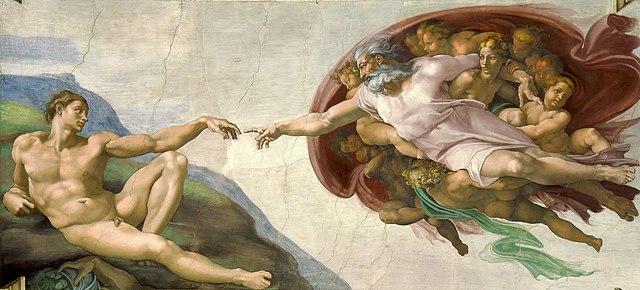
Image: Michelangelo (1475–1564), The Creation of Adam. Fresco in Sistine Chapel, circa 1511. Public domain.
Bibliography
Ray Vander Laan, Artemis of the Ephesians, That The World May Know.https://www.thattheworldmayknow.com/artemis-of-the-ephesians#:~:text=What%20role%20did%20Ephesus%20have,the%20cult’s%20purity%20of%20worship.
‘The Temple of Artemis at Ephesus’, University of Warwick. https://warwick.ac.uk/fac/arts/classics/intranets/students/modules/greekreligion/database/clumak/
‘Great Was Artemis of the Ephesians’, NT Wright Online. https://www.ntwrightonline.org/great-was-artemis-of-the-ephesians/
[1] אָדָם (a.dam) ‘man’ (H0120G). The first named man living at the time before the Flood, first mentioned at Gen.2.19; married to Eve (H2332);
father of: Cain (H7014B), Abel (H1893) and Seth (H8352); also translated “man” at Gen.2.19,21,23; 3.8,9,20; 5.2; “mankind” at Deu.32.8; “others” at Job.31.33; Another spelling of a.dam (אָדָם “Adam” H0121) man, human being
[2] זָכָר (za.khar) ‘male’ (H2145) 1) male (of humans and animals) adj 2) male (of humans)
[3] נְקֵבָה (ne.qe.vah) ‘female’ (H5347) 1) female 1a) woman, female child 1b) female animal
 Read with Ssam