Now that Timothy is all filled up with the things he should do to revolutionise the Ephesian congregation, uprooting any trace of falsehood, how is he to truly go about this?
1 Do not rebuke an older man harshly, but exhort him as if he were your father. Treat younger men as brothers,
The good-fight strategy number three starts here. As a reminder, the first was to live a life of prayer in words and deeds so that you may reflect and carry out God’s desire for all people (Ch’s. 2–3). The second strategy was to have such godliness, that is, holding God’s desire in you, only through being with God and by God acting upon me as it pleases him (Ch. 3). The third is a practical way of teaching strategies one and two to Timothy’s community.
With such grave and critical sets of principle of how truly be God’s people, one would think some crash and thump were due. But here comes the longsuffering nature which is the number one characteristics (1 Cor 13:4) of the one who is love (1 John 4:8). If you are teaching God to people, the method of teaching Him should also be God.
2 older women as mothers, and younger women as sisters, with absolute purity.
Despite the fact that he sounded as if he disrespected women previously, this verse shows all the more that it was only to warn believers about the practice that went on surrounding the women priests in the Artemis temple.
3 Give proper recognition to those widows who are really in need.
The NIV’s liberal translation, ‘widows who are really in need’, is more helpful in understanding the nuance in comparison to the ESV’s and NASB’s literal translations, ‘truly widows’ or ‘actually widows’. Nevertheless, the ESV and NASB seem to have kept closer to the original structure, viewing the widow as the symbolic Old Testament word that represented the poor who needed mercy along with the orphan.
4 But if a widow has children or grandchildren, these should learn first of all to put their religion into practice by caring for their own family and so repaying their parents and grandparents, for this is pleasing to God.
But even with such longsuffering and merciful love, it is not blind love that represents God. Rather, it is responsible and building up love that is sustainable and making it available to all people in various ways.
Dear God, we marvel at your thoughts and your wisdom. You are kind and merciful, yet you are building us up so that we may be kind and merciful to those to whom we have to be kind and merciful. Let us not misuse your name when we wilfully neglect our parents, brothers and sisters, or friends, saying that it is to do God’s work, because it is not! You never puff us up, Lord, but you build us up to the perfection of being filled with you! Teach us your way so that we can teach others in your way too. Let us be prayerful and godly in your manner, the manner of sending Your Son, your very self. Praise, love, and honour be to our true God.
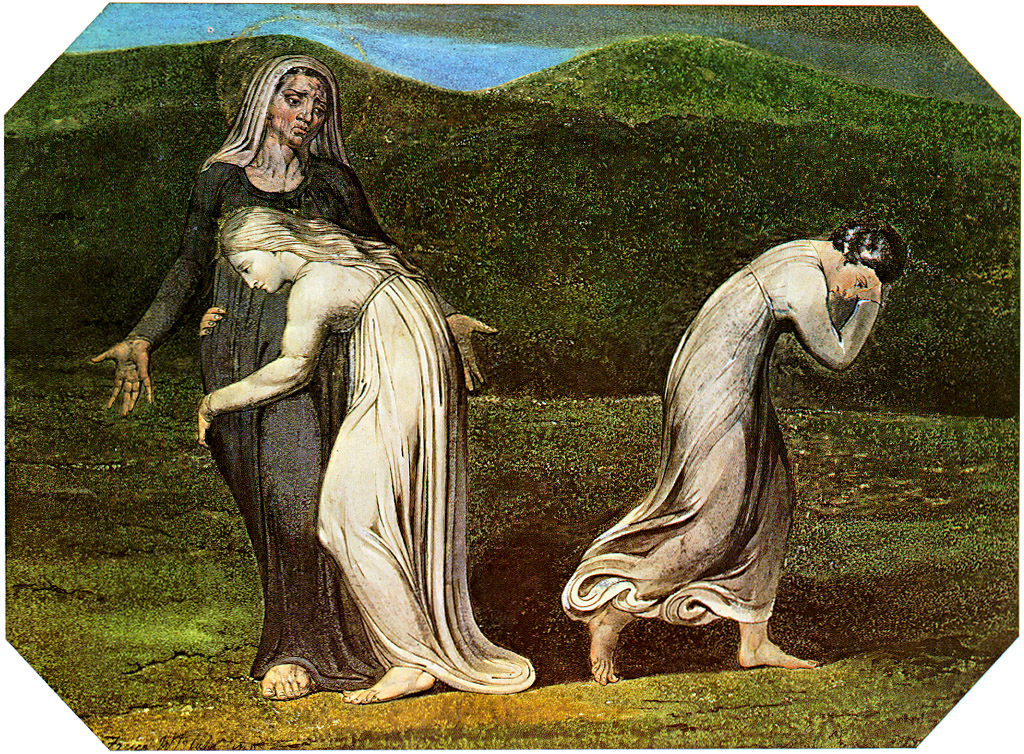
Image: Naomi entreating Ruth and Orpah to return to the land of Moab, 1795, William Blake. Public Domain via Wikimedia
 Read with Ssam