Today’s short passage is about who should be on the list of poor relief recipients. Reading these words, watch how your mind travels out searching, but make sure it comes back to the first and foremost point.
9 No widow may be put on the list of widows unless she is over sixty, has been faithful to her husband,
Remember how looking after and serving widows was the centre of the issue in appointing the first deacons in Acts 6? Although later we hear only about the deacons’ preaching the gospel rather than physically serving the table, we can nevertheless get a glimpse that providing welfare for the widows was something that was a handful and could easily get out of control in those days. Thus Paul gives Timothy, a second-generation leader, detailed instructions regarding the subject so as not to lose focus on the things that have been said so far, namely to do with fighting the good fight to reveal God’s desire for all people. We, as the reader, should also remember time and again to stick to the point of the letter. ‘Has been faithful to her husband’ is again the NIV’s liberal translation. ‘Having been the wife of one husband’ (ESV, NASB) reflects the original wording better.
10 and is well known for her good deeds, such as bringing up children, showing hospitality, washing the feet of the Lord’s people, helping those in trouble and devoting herself to all kinds of good deeds.
The participle clause ‘having been testified in good deeds’, together with the previous ‘having been the wife of one husband’, qualifies the main clause ‘let a widow be enrolled if she is not less than sixty years old’ (unlike the NIV’s wording, this is not a negative sentence). The two participle clauses, ‘married to one man’ and ‘testified in good deeds’, are therefore of the same (or at least similar) quality that can bring forth the subsequent actions in caring for her family, serving believers, confessing her faith in words and deeds, etc. When, as discussed previously, we remember that any believer’s good deed to be testified for is first and foremost washing their garment in Christ’s blood, it humbles down any other attempts at interpreting these verses in any other world-resembling criteria-setting way. It highlights all the more who the husband in v. 9, whether the NIV way or otherwise, should really imply.
Lord, my Master, thank you for your word today, which could be easily taken as dry and unrelated. But every word of yours builds me up so that I do not lose focus on what you are really telling me to follow and stick to. Yet your word also humbles me to lose my eagerness and effort to drive my thoughts my own way. Lord, let us not be bogged down by seemingly immediate and urgent things and thus be hindered in thinking and pursuing your way—your desire to tell all people about you and let them come to know the truth through me! Let us not side with worldly criteria when yours is always ‘love’ that builds up and does not puff up. Let every believer keep washing their coats in your blood so that we always rely on your deeds and power and not at any time our own. Lord, have mercy on me, a sinner, a sinner you loved.
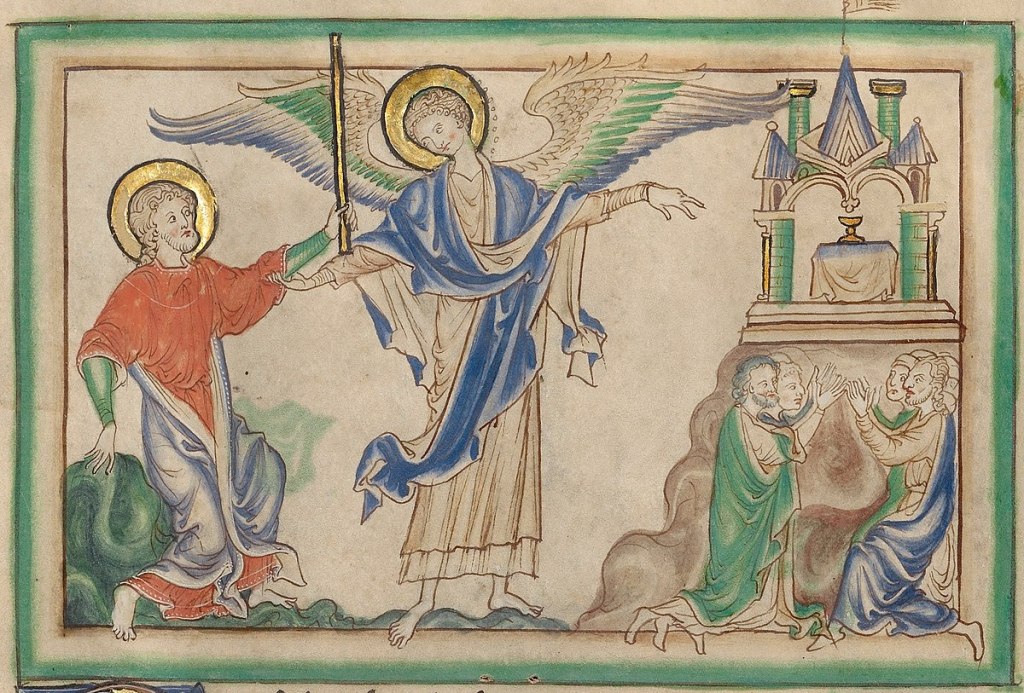
Image: Saint John Takes the Rod to Measure the Temple, unknown artist. Getty Center, Public domain, via Wikimedia Commons.
 Read with Ssam