We confess that we are followers of Jesus. Then, no doubt, our confession should also follow that of Jesus, even if it pierces us.
11 But you, man of God, flee from all this, and pursue righteousness, godliness, faith, love, endurance and gentleness.
‘All this’ refers to ‘unhealthy interest in controversies and quarrels about words that result in envy, strife, malicious talk, evil suspicions’ (v. 4), ‘constant friction between people of corrupt mind’ (v. 5). They are signs of love of money (v. 10), which is the desire to ‘justify oneself’ (Luke 16:14–15, Luke 10:29).[1]
Then, ‘righteousness (more in the sense of piety in line with other qualities than God’s redemption itself), godliness, faith, love, endurance and gentleness’ are the signs of the opposite—the desire to be justified by ‘the true Justifier of the one who has faith in Jesus’ (Rom 3:27).
12 Fight the good fight of the faith. Take hold of the eternal life to which you were called when you made your good confession in the presence of many witnesses.
This verse folds symmetrically back to 1:18–19, which is about fighting the battle well, holding on to faith, and having a good conscience. Here, these qualities are translated as ‘making good confession’, as a lead to Jesus’ confession in the next verse. The battle against falsehood is magnified as ‘taking hold of the eternal life’, which also alludes to Jesus’ going to the cross after the confession (Heb 12:2, John 3:16, John 6:54, John 17:3).
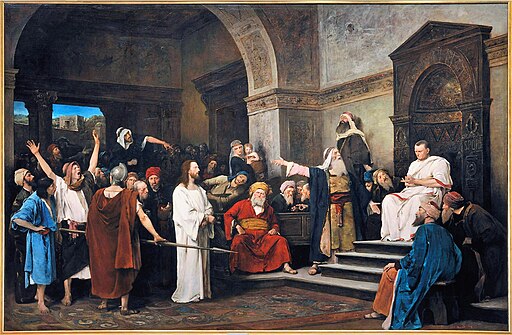
13 In the sight of God, who gives life to everything, and of Christ Jesus, who while testifying before Pontius Pilate made the good confession, I charge you
Timothy’s confession is likened to Jesus’ confession before Pilate, which we should hold on to as the basis and grounds for our confession. Of the Gospels, John 18 and 19 most extensively record ‘Jesus’ confession’. To Pilate’s question if he was the King of the Jews, Jesus proclaims, ‘My kingdom is not of this world’ (John 18:36), ‘I was born and came into the world to testify to the truth’ (John 18:37), and ‘You would have no power over him if it were not given to you from above. Therefore the one who handed me over to you is guilty of a greater sin’ (John 19:11).
Surprisingly, at the end of Jesus’ confession before Pilate, we are brought back to the people’s sin, who boldly confess at the end of the scene, ‘We have no king but Caesar!’ (John 19:15). Their appealing and siding with the one to whom ‘money’ belongs (Matt 22:20, Mark 12:16, Luke 20:24) at this particular time is significant, for it proves that ‘money’ is the symbol and pinnacle of the desire to make oneself look right—to justify oneself—and that this is the complete opposite of the truth Jesus came to testify.[2]
14 to keep this command without spot or blame until the appearing of our Lord Jesus Christ,
What command? It points, first of all, to the imperatives that have been said immediately before, in vs. 11–12, i.e., to fight the good fight, etc. But they are the essence of the whole letter: to fight against falsehood. Falsehood deludes you into believing that you are able to justify yourself and therefore should desire it—’the love for money’, as Luke puts it (Luke 16:14). This directly stands up against and defies the love for God (Matt 6:24), who commanded: ‘Walk before me faithfully and be blameless‘ (Gen 17:1), because He will make us!
15 which God will bring about in his own time – God, the blessed and only Ruler, the King of kings and Lord of lords,
God, who has commanded and ordained it, has everything under control and will make it come to pass.
16 who alone is immortal and who lives in unapproachable light, whom no one has seen or can see. To him be honour and might for ever. Amen.
To such a flawless, perfectly wise, and powerful God, our doxology is due along with Paul’s.
Dear Lord, all along I wanted to believe the crucifixion of our Lord was a faraway story from me. But the voices shouting, ‘Crucify him!’ and ‘We have no king but Caesar!’ were just my own voice trying to justify myself and to hide my trying to justify myself. I must have thought if I hid it under that many layers, no one would know, including you. But, O Lord, you are there even if I make Sheol my place to sleep (Ps 139:8)! You truly know all things. Lord, have mercy on me. Lord, cancel my debts. So that I not only survive death but also live to testify to the truth. That you are the one who justifies us and makes us right. Let us know and testify that this is your true desire for all people and that for this you gave up your dearly loved Son, who is Yourself. Let us live to fight this battle.
Image: Christ in front of Pilate Jezus przed Pilatem, Mihály Munkácsy, 1881. Public domain, via Wikimedia Commons
[1] which seems to be not too far from ‘works of the law’ in Rom 3:28, etc.
[2] Jesus confession not only testified to the truth but also exposed the sin of people. As discussed in 1:5, however, the goal of this is love, agape, as the active love God’s people have for God and people, initiated by the active love of God for his Son and his people. To put them back into this love is the purpose of the fight, going far beyond just judging them and proving them wrong.
 Read with Ssam